Production workflows / Guide 08
A Credit Limit Increase Agent That Prepares Decisions Without Making Them
Design a credit card limit increase agent that gathers verified evidence, preserves decision reasons, supports fairness audits, and leaves credit decisions to humans.
Illustrative engineering guide. Examples are not client deployments, production-ready integrations, or evidence of measured results. Validate the design with your domain and security owners.

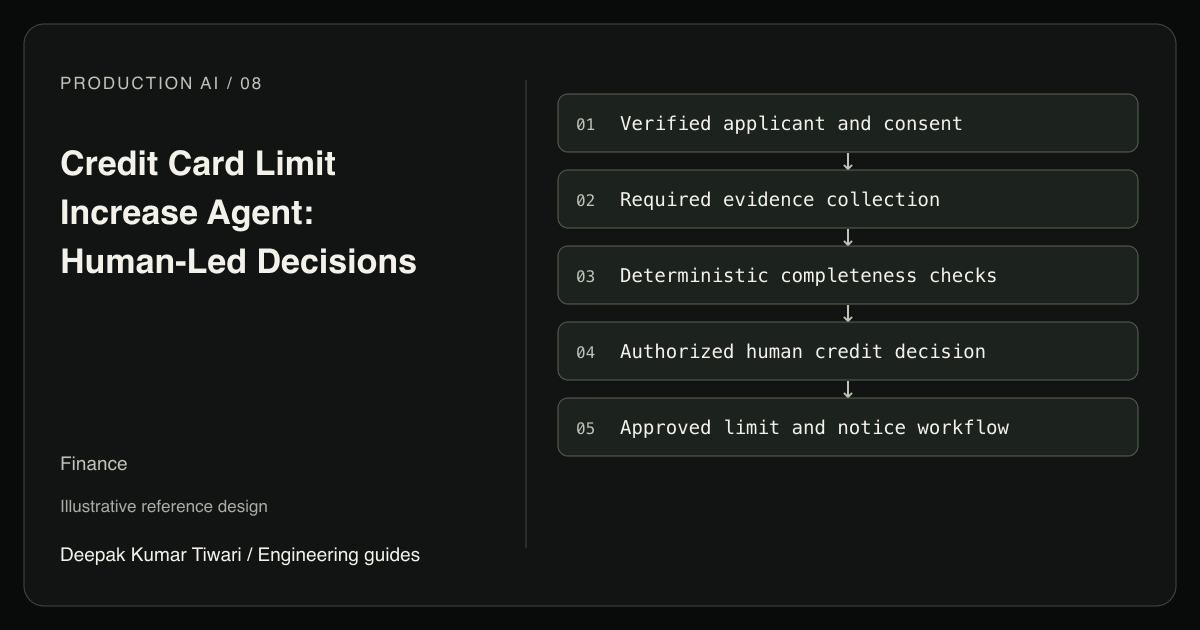
Imagine a hypothetical cardholder requesting a higher limit after receiving a pay increase. They upload a payslip and write a persuasive explanation of upcoming travel. A credit card limit increase agent can help assemble the application, but eloquence is not evidence of repayment capacity. The system should make an application easier to evaluate without letting a language model decide who receives credit.
The appropriate initial boundary is administrative assistance and evidence preparation. An authorized human makes the credit decision using the institution’s approved policy and validated decision process. The assistant must not rank applicants by personality, infer protected characteristics, or convert conversational tone into an undisclosed risk feature.
Define the Evidence Contract First
Separate applicant statements, verified financial records, and computed features. “My salary increased” is a statement. A document may support that statement, but its issuer, date, pay frequency, currency, and authenticity still matter. A single monthly payment is not automatically recurring income, and a gross amount is not interchangeable with a net amount.
Keep source references and verification status attached to each field. If documents conflict, preserve both rather than asking the model to choose the most favorable number. The next action should be a specific clarification, such as confirming whether a bonus is recurring, not a generic request to upload everything again.
Collect only evidence necessary for the approved workflow. Avoid social-media scraping, personality profiling, or protected-attribute inference. Information lawfully retained for a separate fairness audit should remain access-controlled and separated from live underwriting inputs. The exact regulatory duties, notices, and permissible data use require jurisdiction-specific legal and compliance review; this guide does not supply that determination.
Make Completeness Deterministic
The LLM can explain required documents, extract candidate fields, and summarize unresolved questions. Completeness, freshness, consent validity, and required review gates should be deterministic. A high extraction confidence cannot substitute for an expired document, and a complete application is not an approved application.
The following runnable Python example checks only evidence freshness and verification. Dates are integer days in a controlled test clock. The example is not an underwriting model and deliberately returns no credit recommendation.
def evidence_ready(records, required, today, max_age_days):
    if max_age_days < 0:
        raise ValueError("invalid freshness policy")
    for name in required:
        record = records.get(name)
        if record is None or not record["verified"]:
            return False
        age = today - record["observed_day"]
        if age < 0 or age > max_age_days:
            return False
    return True

records = {"income": {"verified": True, "observed_day": 95}}
assert evidence_ready(records, ["income"], 100, 30)
assert not evidence_ready(records, ["income", "consent"], 100, 30)
assert not evidence_ready(records, ["income"], 140, 30)
Production dependencies include authenticated evidence sources, policy-specific freshness windows, consent scope, document verification, and reviewed financial calculations. The institution, not the model, defines which evidence is required for a product and application type.
Build a Human Decision Packet
Use a verified application gateway, document intake service, evidence adapters, completeness evaluator, and review queue. Present the requested limit, current limit, source-backed facts, conflicting values, missing evidence, and policy version. Do not place a model-generated approval recommendation at the top where it can anchor the reviewer before they inspect the record.
Require reviewers to record the actual decision and supported reasons through controlled fields. A language model may draft plain-language explanations from those approved reasons, but it must not invent a more palatable justification after the fact. Review the final notice for factual accuracy and the applicable legal requirements before sending it.
Separate specialist extraction components can help with payslip formats or statement tables when they have independent test sets. A second agent acting as an autonomous credit officer is not an appropriate substitute for human accountability. Deterministic policy checks and retrieval tools should remain ordinary software rather than a simulated committee of agents.
Secure the Decision and the Update
Server-side authentication must establish the applicant and account relationship. Scope every document, application, and card lookup to the proper tenant and authorized user. Follow OWASP authorization guidance by denying access by default and validating permissions on every request, including staff review and final limit changes.
Uploaded statements and applicant messages are untrusted. Instructions embedded in a PDF cannot mark verification complete or manufacture approval. OWASP prompt-injection guidance supports independently validating actions and limiting tool authority. MCP is an integration protocol, not authorization to change a credit line.
Bind approval to the exact application version, evidence version, proposed limit, policy version, and reviewer identity. Immediately before execution, recheck account state and approval validity. If new adverse or conflicting information arrives, pause the update for human review rather than carrying forward stale approval.
Limit updates need a durable operation identifier and an expected account version. If the response is lost, read the authoritative account state and operation history before retrying. RFC 9110 defines conditional HTTP requests, but the card platform’s actual contract determines available concurrency protection. A failed notification must not trigger another limit update.
Acceptance Tests That Protect Applicants
- Supply an unverified document with a clearly readable high income. The application remains incomplete and receives no automatic credit decision.
- Change only an applicant’s name or conversational style in paired administrative test cases. Required evidence and routing remain the same when all permitted relevant inputs are identical.
- Embed an instruction to approve the request in a statement. Verification and decision fields remain unchanged, and no limit tool runs.
- Modify the requested limit after human approval. The approval becomes invalid and the new request returns to the reviewer.
- Lose the limit-update response after success. Reconciliation confirms one change; the customer notice is sent only from verified final state.
Measure Helpfulness and Unequal Error Burdens
Baseline manual application preparation by document type, completeness, channel, and product. Measure review-ready applications with correctly verified required evidence divided by all eligible submitted applications. Also track the number of clarification rounds and time from submission to human decision. Faster extraction alone is not evidence of a better credit process.
Guardrails include unsupported decision reasons, unauthorized updates, incorrect income extraction, and avoidable requests for unnecessary documents. Conduct authorized fairness audits of administrative errors, delays, and reviewer overrides across legally appropriate groups and intersections. Use controlled audit data; do not ask the live model to infer group membership. Investigate differences rather than treating aggregate accuracy as sufficient.
Roll out as staff-visible preparation for one application type, with mandatory human decisions and notices. Proposed expansion gates should require reproducible evidence and acceptable audited error patterns, not a higher approval rate. Start by writing the evidence contract. The home-loan application guide extends document preparation to longer cases, while bank support covers customer communication. AI systems engineering can establish these boundaries before introducing more automation.