Multimodal inspection / Guide 93
3D Printer Failure Detection Must Not Wait for Telemetry Agreement
Build a 3D printer failure detection harness that preserves visual hazard escalation, checks fresh evidence, and never delays independent safety interlocks.
Illustrative engineering guide. Examples are not client deployments, production-ready integrations, or evidence of measured results. Validate the design with your domain and security owners.

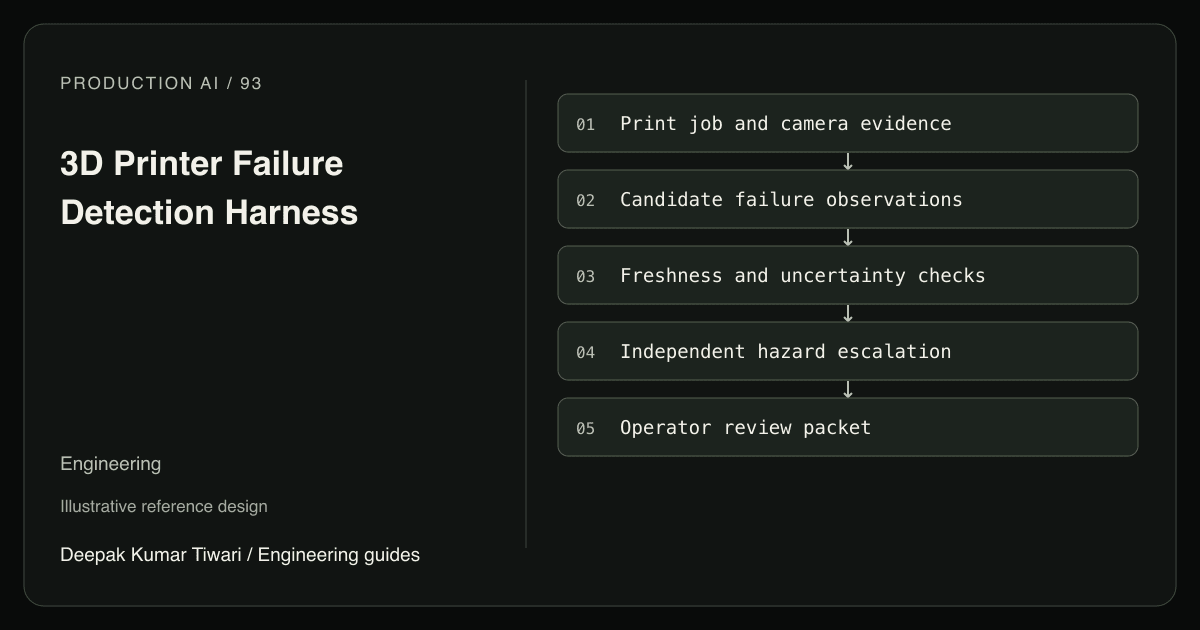
A hypothetical printer camera shows loose filament collecting around the hot end while the dashboard reports a normal nozzle temperature. A naive assistant dismisses the image because telemetry looks healthy. That is the dangerous failure: an expected sensor value does not cancel visible evidence of a possible hazard. A useful inspection harness preserves the disagreement and routes it to the operator without delaying independent safety protections.
Separate ordinary quality concerns, such as suspected stringing, from potential hazards, such as smoke-like imagery or a detached object interfering with motion. RGB imagery does not establish temperature or prove that a plume is smoke. Uncertainty about classification is nevertheless not permission to ignore the observation. Existing emergency procedures and independent safety interlocks must act on their own inputs, without waiting for a model, network response, or human review packet.
Identify the Actual Print
Bind camera evidence to printer identity, print job token, G-code digest, slicer version, material profile, and machine configuration revision. Layer number alone is not unique: the next job may use the same layer count. Record job start, restart events, camera stream identity, decoded frame timestamps, and capture receipt time. A recycled thumbnail must not be mistaken for the current chamber state.
FFprobe’s documentation provides frame and stream inspection facilities. Preserve the stream time base and actual presentation times rather than assuming every image arrives at a constant interval. Timelapse footage is especially unsuitable for real-time response unless the capture schedule is explicit. Ten repeated frames of the same extrusion tangle do not constitute ten independent failures or ten independent confirmations.
For overlays, use top-left pixel coordinates and preserve crop transforms. For comparisons with toolpaths, define bed coordinates in millimeters and the bed-to-camera registration version. OpenCV’s calibration tutorial explains image and object coordinates, distortion, and reprojection error. A bed-plane mapping cannot accurately locate every feature rising above that plane; tall parts require a suitable spatial model or an explicit limit on measurement claims.
Keep Safety Outside Consensus
A specialist adapter can compare an observed silhouette with the expected layer envelope and return a bounded discrepancy. Another adapter can retrieve authenticated firmware telemetry with Celsius units, sample time, sensor identity, and calibration information. These are measurements from different mechanisms, not votes in a majority election. Normal thermal readings cannot veto an optical hazard candidate.
Klipper’s configuration reference documents heater verification and temperature-related configuration. Its documented protections are not a claim that every failure is detectable by that sensor. Do not relax firmware limits to make an assistant’s observations agree with a nominal print. A safety specialist must determine the actual protection architecture, including protections independent of this advisory application.
Define outcomes with different meanings: potential-hazard escalation, quality review, insufficient evidence, and observation packet. None means safe to continue. The advisory system should never promise that an alert caused a stop; only an authoritative machine receipt could establish a particular commanded state, and even that is not proof that all physical hazards are controlled.
A Priority and Freshness Fixture
This self-contained Python example tests the HARNESS with synthetic metadata and silhouette measurements. It does not test a trained vision model, camera, printer, CAD engine, safety interlock, or real inspection performance. All thresholds are illustrative policy values. The function returns text only and performs no physical action.
from math import isfinite

base = dict(job="job-7", frame_age_s=0.5, frame_visible=True,
            thermal_normal=True, potential_hazard=False,
            silhouette_error_mm=0.3, bound_mm=0.1)

def route(row):
    # Hazard concerns survive even stale or conflicting supporting evidence.
    if row["potential_hazard"]:
        return "potential-hazard-escalation"
    if row["job"] != "job-7" or not row["frame_visible"]:
        return "insufficient-evidence"
    age, error, bound = (row["frame_age_s"], row["silhouette_error_mm"],
                         row["bound_mm"])
    if not all(isfinite(v) and v >= 0 for v in (age, error, bound)):
        return "insufficient-evidence"
    if age > 2:
        return "insufficient-evidence"
    if error + bound > 1:
        return "quality-review"
    return "observation-packet"

assert route(base) == "observation-packet"
assert route(dict(base, potential_hazard=True)) == "potential-hazard-escalation"
assert route(dict(base, potential_hazard=True, frame_age_s=99)) == "potential-hazard-escalation"
assert route(dict(base, frame_age_s=99)) == "insufficient-evidence"
assert route(dict(base, silhouette_error_mm=2)) == "quality-review"
assert route(dict(base, frame_visible=False)) == "insufficient-evidence"
print("six synthetic routing checks passed; no machine action")
The unused normal-telemetry flag is intentional: it cannot suppress any result. A stale hazard observation still generates an escalation whose packet must explain its age and uncertain current relevance. That does not authorize sending a stop command to whichever printer happens to be active. The operator follows the established safety procedure while resolving identity and freshness separately.
Production requires typed input validation, authenticated device binding, reliable alarm delivery, clock synchronization bounds, persistent incident state, and tested failure behavior. The silhouette bound should include lens calibration, segmentation uncertainty, and registration uncertainty; it is not supplied by a language model’s confidence score. Record unavailable or unvalidated calibration as unknown rather than inventing a millimeter estimate.
Coverage and Operator Ownership
Define the requested coverage as visible bed sectors and relevant print intervals. The rear of a tall part may hide a detached support; a top camera may not see a lower layer separating. Track unseen regions and outage duration independently. A quality packet should identify the earliest supported observation and the longest capture gap, not just display the most dramatic frame.
The operator may inspect the machine, request better imagery, or follow an approved interruption and recovery procedure. Keep safety escalation separate from ordinary ticket deduplication so grouping repeated observations never delays an urgent notification. If a ticket write times out, reconcile its incident identifier before retrying; do not interpret that timeout as an unsuccessful machine stop.
Authorize camera and telemetry access server side per machine group. Keep uploaded labels and visible screen text untrusted. The model cannot modify firmware, change temperature limits, restart a job, or clear an interlock. Maintenance workflow design explains assignment and repair ownership; visual triage supplies evidence to that workflow rather than inheriting its actuation permissions.
Acceptance Tests and Evaluation
- Combine a potential hazard observation with normal telemetry; escalation remains mandatory and is not downgraded.
- Disconnect the model service; independent safety interlocks and existing emergency procedures remain unaffected.
- Replay an old job’s image; ordinary quality interpretation returns insufficient evidence for the active job.
- Obscure the hot end; no temperature or safe-continuation conclusion is generated from RGB.
- Freeze the video while timestamps advance; the ingestion health check identifies repeated content and reports degraded coverage.
- Retry incident delivery after a timeout; preserve one incident identity without suppressing urgent escalation.
Evaluate complete print runs with expert-labeled incident windows, not shuffled neighboring frames. Compare with the current operator monitoring baseline. Report detected adjudicated incidents divided by all adjudicated incidents, false alerts per monitored print hour, and unobserved minutes divided by scheduled monitoring minutes. Measure advisory latency separately from independent safety response; never use a fast model average to justify delayed protections.
Begin in shadow mode on noncritical print quality observations while leaving existing safety systems untouched. Printed-part scan comparison addresses completed geometry, not process safety. The first AI systems implementation deliverable should be a provenance-aware alert packet and outage drill, with no printer control capability attached.