Production workflows / Guide 12
An Insurance Claims Agent That Preserves the Evidence Behind Every Decision
Design an insurance claims agent that assembles policy and loss evidence, handles missing documents, prevents duplicate payments, and keeps decisions with adjusters.
Illustrative engineering guide. Examples are not client deployments, production-ready integrations, or evidence of measured results. Validate the design with your domain and security owners.

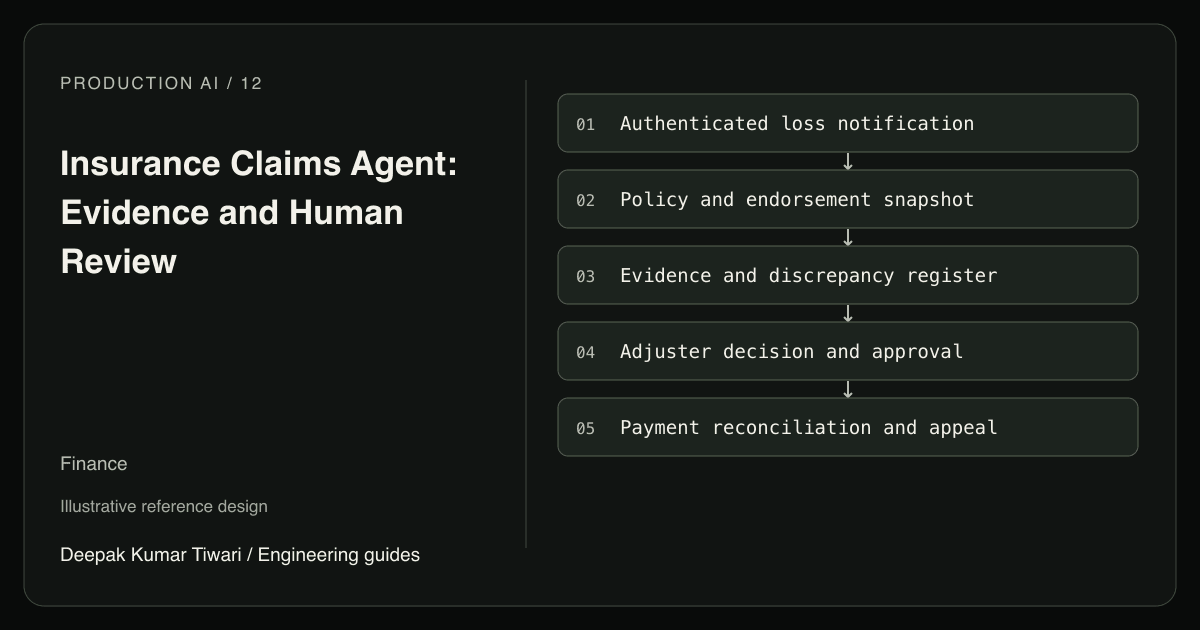
A hypothetical homeowner submits a storm-damage claim with roof photographs and a contractor estimate. The policy renewed last month, an endorsement changed a deductible, and the reported loss date falls before renewal. A convincing summary of the newest policy would be worse than no summary: it could make the wrong terms look authoritative.
An insurance claims agent should organize evidence around the policy and circumstances applicable to the loss. It should not autonomously deny coverage, label a claimant fraudulent, or release money because a language model sounds certain. The useful product is an adjuster’s review packet with traceable gaps, not a machine-generated verdict.
Separate observations, policy terms, and judgments
Create three distinct records. Observations contain claimant statements, photographs, inspection findings, and repair estimates. Policy evidence contains the applicable contract, endorsements, coverage dates, and relevant clauses. Judgments contain an authorized professional’s interpretation and decision rationale.
An LLM can extract a reported loss date and identify passages about roof damage. It cannot establish that the date is true or that a retrieved exclusion applies. Photographs may show visible damage without proving its cause. Preserve those limits in the packet instead of collapsing everything into a single confidence score.
The NAIC’s AI overview describes insurer responsibility for fairness, accuracy, and oversight when using AI. Treat that as governance context, not a claim that one architecture satisfies every state’s requirements. Applicable rules, notices, timelines, and review rights must be established by the insurer’s legal and compliance owners.
Build the claim packet before the decision engine
Begin with authenticated first-notice intake, policy-version retrieval, document ingestion, evidence indexing, a discrepancy register, and an adjuster queue. Existing claim administration remains the system of record. Store links to evidence there rather than creating an opaque second claims database.
Ingestion should retain the original file, its digest, upload time, source party, and any transformation used for OCR. A transcription correction creates a new extraction version without rewriting the original statement. Search results need page references and document versions so an adjuster can reproduce what the assistant saw.
Use deterministic checks for policy effective dates, missing mandatory fields, arithmetic, and duplicate document identifiers. The model’s contribution is explaining why a packet is incomplete and drafting a specific request: “Please confirm whether the quoted roof area includes the detached garage.” That is more useful than asking the claimant to resubmit every document.
Specialist sub-agents can earn their cost when property, medical, and repair-estimate evidence require genuinely different access scopes and evaluations. They should return bounded findings to one case record. A committee of agents voting on coverage is not independent professional judgment.
Encode uncertainty explicitly
This illustrative JSON contract describes a discrepancy, not a real insurer API. Null means evidence is unresolved; it must not be converted into false or zero.
{
  "claim_id": "claim-example-42",
  "policy_snapshot": "policy-example-v7",
  "finding_type": "loss_date_conflict",
  "observations": [
    {"source": "intake-v1", "value": "2026-08-29"},
    {"source": "inspection-page-2", "value": "2026-09-02"}
  ],
  "resolved_loss_date": null,
  "next_action": "adjuster_review",
  "coverage_decision": null,
  "payment_authorized": false
}
Production dependencies omitted here include schema validation, identity, policy administration adapters, immutable evidence storage, jurisdiction-specific workflow clocks, and the approval service. Validate identifiers against the authenticated claim, not merely against JSON syntax.
In the hypothetical roof case, the date conflict should suspend automated completeness conclusions that depend on coverage version. It should not suspend ordinary claimant support or hide the original filing time. Staff can continue requesting independent evidence while the system clearly marks the unresolved policy selection.
Keep approval distinct from payment delivery
An adjuster-approved settlement should bind the amount, currency, payee, coverage allocation, policy snapshot, and decision version. A later estimate supplement creates a new decision, not an edit that retroactively changes an approved payment instruction. Apply maker-checker separation where the insurer’s policy requires it.
Persist a payment operation ID before submitting to the payment rail. A timeout creates an unknown delivery state. Reconcile against the provider’s reference before retrying, and never generate a fresh reference merely to escape an error. A paid claim may still need accounting reconciliation; a rejected transfer may require a corrected payee workflow rather than a repeat of the old instruction.
Do not let document resubmission create a new claim automatically. Match exact submission identifiers first and flag likely duplicate incidents for review. Two claims at one address can represent distinct losses, so fuzzy similarity is a triage signal rather than grounds for merging or denial.
Protect the evidence pipeline
Enforce server-side organization, policyholder, claim, and staff-role permissions on every read. Separate access to medical material from ordinary property evidence where needed. PostgreSQL row security offers an additional boundary, but privileged-role bypass means it cannot replace application authorization.
Treat contractor estimates, attachments, and scanned letters as hostile input. A hidden instruction to change bank details must never become an authorized action. Use constrained output schemas, allowlisted tools, and independent payment approval, following the layered approach discussed in OWASP’s injection guidance. MCP is an integration protocol, not an authorization system.
Retain an accessible human escalation and correction path. Do not infer protected attributes or use neighborhood, writing style, or upload-device characteristics as proxies for claimant credibility. Fairness review should examine missing-document requests and delays as well as final decisions; friction can be harmful before a denial occurs.
Acceptance tests for contested and incomplete claims
- Give the system a loss date before renewal and a newer policy with different terms. It selects the applicable snapshot or raises ambiguity rather than defaulting to the latest document.
- Remove an estimate attachment after OCR ingestion fails. The packet shows missing evidence and preserves intake time; it does not invent an amount.
- Embed payment instructions inside a contractor PDF. No payee change occurs without the separate authenticated approval workflow.
- Simulate an approved transfer whose response is lost. Reconciliation returns one payment and the original operation ID remains stable.
- Correct the loss date after adjuster approval. The old decision remains auditable and dependent actions require renewed review.
Measure useful preparation, not faster denials
Baseline adjuster preparation time by claim type and complexity. Measure packets accepted without material factual correction divided by all reviewed packets, and total preparation minutes divided by cases reviewed. Track unsupported adverse recommendations, claimant rework requests, and missed workflow deadlines as guardrails.
Use lawfully governed audit data to examine error and delay differences across relevant groups; never infer sensitive characteristics to populate the audit. Report uncertainty when samples are small. Start with retrospective cases, then shadow live intake, then staff-reviewed document requests. Any speed target is proposed until observed in that rollout.
The first implementation should resolve policy versions and preserve evidence citations for one claim category. The insurance weather risk guide addresses external hazard evidence, while the suspicious transaction investigation guide explores neutral investigation records. AI Systems, RAG & Agents can support this bounded workflow without positioning automation as a substitute for claims professionals.