Production workflows / Guide 45
A News Research Agent That Separates Repetition From Corroboration
Build an AI news research agent that traces claims to original sources, detects recycled coverage, tracks corrections, and leaves publication with human editors.
Illustrative engineering guide. Examples are not client deployments, production-ready integrations, or evidence of measured results. Validate the design with your domain and security owners.

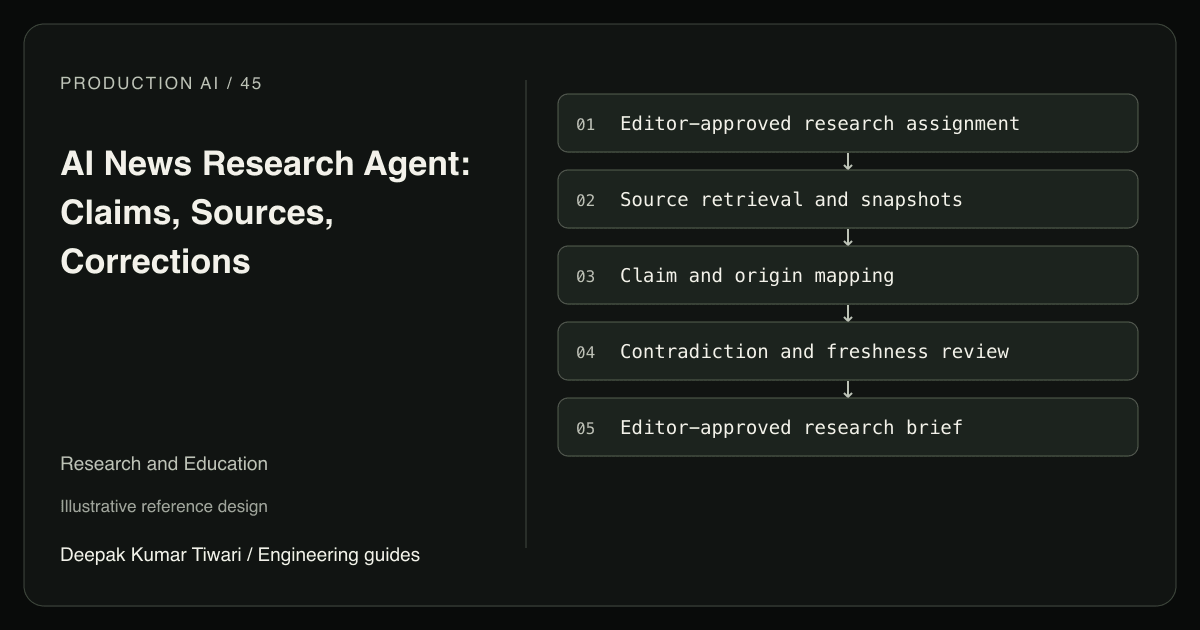
Suppose a hypothetical newsroom is investigating a company’s claim that a new facility has opened. Six websites repeat the same press release. A seventh reports that permits remain pending. A research agent that counts URLs as independent confirmation will produce the wrong kind of confidence precisely when the editor needs uncertainty made visible.
The deliverable should be a claim ledger and a source map, not a publish-ready article disguised as verified reporting. Each claim needs an origin, supporting evidence, contrary evidence, and a freshness status. Editors decide what can be published, what needs direct reporting, and how allegations should be attributed.
Track Claims at the Right Granularity
“The facility opened and created hundreds of jobs” contains at least two claims with different evidence requirements. A ribbon-cutting photograph might support that an event occurred, not that production began. A hiring announcement does not establish filled positions. Split such sentences before judging support.
Record who made the claim, the original wording, when it was made, what event time it refers to, and what the evidence actually demonstrates. An official statement is primary evidence of what an organization said. It is not automatically independent proof that the underlying statement is true.
Use provenance concepts from the W3C PROV overview to connect source artifacts, extraction activities, and reviewer decisions. A relational claim-to-source table is enough initially. The important feature is derivation: six rewrites of one release should remain visibly connected to one origin.
Retrieval Needs a Coverage Ledger
The minimum architecture has an authenticated assignment workspace, a restricted fetcher, a snapshot store, claim extraction, origin grouping, and an editorial review queue. The model proposes claims, questions, and possible contradictions. Software enforces source permissions, timestamps, identifier handling, and whether a cited artifact actually exists.
Save successful fetches and failed attempts separately. A blocked page is not a source the agent has read. If only a search snippet is available, label it as a lead and do not attach it to a detailed factual assertion. A deadline should reduce the brief’s claimed coverage, not encourage the model to fill gaps from memory.
For science reporting, Crossref’s REST API provides bibliographic metadata and available post-publication updates. Use it to resolve a paper’s identity, then read the accessible source before assessing its claims. Metadata and abstracts can be incomplete, and absence of an update does not guarantee a paper remains reliable.
A specialist sub-agent can earn its cost for a distinct source domain, such as scientific methods or public records, when its output has a separate evaluation rubric. Several agents reading the same syndicated story do not create independent corroboration. Fetching and URL normalization should remain deterministic tools.
Represent Independence Explicitly
The following illustrative JSON contract describes a synthetic claim. It is not a real news event or an external API schema.
{
  "claim_id": "fixture-facility-1",
  "claim": "Commercial production has begun",
  "as_of": "2026-09-07T12:00:00Z",
  "support": [
    {"source_id": "release-v1", "origin_group": "company-release"},
    {"source_id": "rewrite-v1", "origin_group": "company-release"}
  ],
  "contrary_evidence": ["permit-register-snapshot"],
  "independent_support_groups": 1,
  "status": "requires_reporting",
  "next_question": "Which permit authorizes current production?"
}
Production dependencies include schema validation, source authentication, access rights, archival policy, editorial review, and secure storage. Origin grouping is itself a reviewable hypothesis. Two reports might share a release but contain distinct interviews; group evidence at the passage level when document-level grouping would erase that reporting.
Do not convert source count into a universal truth score. One authenticated public record can outweigh many unattributed summaries for a particular claim. Conversely, an official register can lag events. Show the editor the mismatch and its possible explanations instead of using majority voting to settle it.
Corrections Are New Versions, Not Silent Edits
Keep fetched-at time separate from published-at and event time. A page updated today may describe an event from last year. The HTTP semantics specification defines validators and conditional requests useful for efficient refreshes, but an ETag is not an editorial correction label. A content change still needs comparison and interpretation.
When a source retracts a number, invalidate dependent claims and notify the assignment owner. Preserve the old snapshot where storage rights and retention policy allow, record the replacement relationship, and expose the affected brief versions. A corrected research brief should explain what changed rather than simply presenting a new confident summary.
Use server-side authorization for assignments, embargoed documents, source identities, and exports. Tenant boundaries must apply to caches and search indexes as well as the primary database. A public-source agent should never have access to confidential source notes unless the assignment explicitly requires it.
Fetched pages are untrusted. Embedded instructions cannot change an editor’s assignment, access credentials, or publish content. The fetcher should block private-network destinations, unsafe redirects, excessive downloads, and credential forwarding across origins. MCP tools do not authorize broader access merely because the model discovers them.
Retry reads with bounded backoff and preserve failed coverage. Saving a brief uses a stable assignment-and-version identifier. Publishing, contacting sources, or sending allegations externally requires distinct human approval and idempotent delivery tracking. The research worker should have none of those permissions by default.
Acceptance Tests for an Editorial Desk
- Feed six rewrites of one press release. The brief reports one shared origin and does not claim six independent confirmations.
- Supply a page whose publication date is current but event date is old. The timeline uses the event date and identifies the later publication separately.
- Return an access-denied response for a crucial record. The claim remains unresolved, with the failed retrieval visible in coverage notes.
- Change a source number after a brief is approved. The system marks dependent claims stale and creates a correction task without silently altering the approved artifact.
- Embed instructions requesting embargoed notes in a public page. No private workspace read or outbound disclosure occurs.
Also test a name collision between two people and a quote clipped so its negation disappears. Both should route to explicit identity or context review rather than pass through a generic confidence threshold.
Measure Useful Research and Missed Context
Baseline editor time for a fixed class of assignments. Measure claim traceability as factual claims with valid supporting locators divided by all factual claims in the brief. Measure corroboration accuracy as correctly grouped evidence relationships divided by relationships adjudicated by editors. Report unresolved claims rather than removing them from the denominator.
The guardrails are unsupported publishable assertions, missed corrections, and confidential-source exposure. Run the agent in shadow mode on archived assignments, then use it as an internal research assistant with publication disabled. Proposed speed targets should include time spent checking and correcting the brief; shorter generation latency alone is not newsroom value.
Start with one evolving announcement and its original documents. The investor research guide explores financial evidence boundaries, while the pharmaceutical research guide develops study-level attribution. AI systems and agent engineering supports the provenance foundation. The first success criterion is an editor finding the weakest claim quickly.