Production workflows / Guide 43
A Pharmaceutical Research Agent That Does Not Flatten Evidence
Build an AI pharmaceutical research agent that preserves study populations, endpoints, publication updates, and uncertainty in scientist-reviewed evidence tables.
Illustrative engineering guide. Examples are not client deployments, production-ready integrations, or evidence of measured results. Validate the design with your domain and security owners.

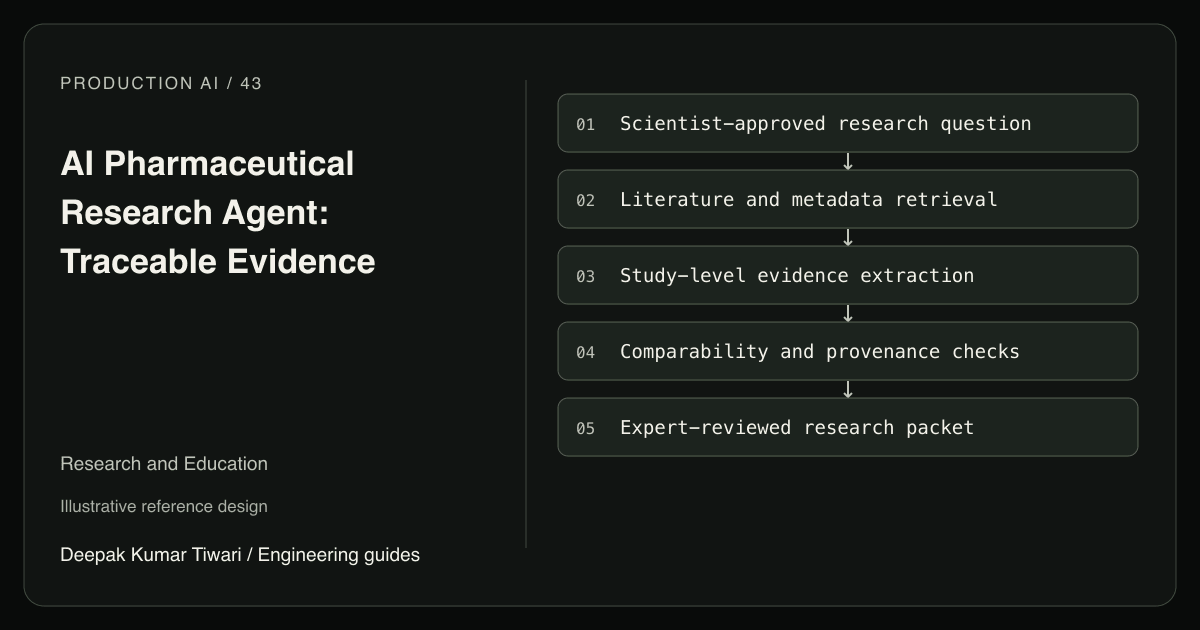
Consider a hypothetical pharmaceutical research team comparing published evidence for a therapeutic mechanism. One paper reports a biomarker change in cultured cells, another describes an exploratory endpoint in a small human study, and a review cites both. An LLM can turn those documents into a fluent paragraph suggesting consistent clinical benefit. That paragraph would erase the most important differences.
The agent’s job is to build an evidence table that scientists can challenge. It should preserve population, intervention, comparator, endpoint, time horizon, and study limitations before attempting synthesis. This is an illustrative research workflow, not a claim about any molecule, a treatment recommendation, or a substitute for scientific review.
Start With a Question That Can Exclude Papers
Ask the scientist to define the research question, eligible study designs, relevant populations, and the decision the packet supports. “Find evidence about this target” is too broad to evaluate. “Identify human studies measuring this endpoint in this disease population” gives retrieval and exclusion logic a useful boundary.
Store query strings, database names, run times, filters, and excluded-record reasons. The NCBI E-utilities documentation describes structured search and retrieval interfaces for Entrez databases. Use supported interfaces and current usage guidance rather than asking a browsing model to invent citations from memory.
Deduplicate at both publication and study level. Multiple papers may report the same participants at different follow-up times. A review is not independent replication of the studies it cites. Retain publication relationships and let reviewers confirm uncertain study linkage instead of merging solely because author lists look similar.
Build Evidence Rows Before Narrative
The smallest architecture needs retrieval connectors, a document store, a structured extraction step, comparability checks, and an expert review queue. The LLM proposes evidence fields and explanatory text. Deterministic software validates identifiers, required fields, unit formats, source spans, and whether a claim cites an accessible document version.
Use separate fields for an author’s conclusion and the system’s interpretation. Preserve “not reported” rather than replacing it with zero. A missing adverse-event count does not mean no adverse events occurred. Likewise, an inaccessible full text should remain an abstract-only record with explicit limitations.
The following illustrative JSON contract shows a synthetic evidence row. It is an internal design example, not a real study or an official API response.
{
  "study_key": "synthetic-study-A",
  "publication_key": "fixture-publication-1",
  "population": "Protocol-defined adult cohort",
  "design": "randomized_comparison",
  "endpoint": {
    "name": "protocol-defined symptom score",
    "role": "exploratory",
    "timepoint_days": 84,
    "effect_value": null,
    "uncertainty": "not_extracted"
  },
  "source": {
    "document_version": "fixture-v1",
    "locator": "Results, table 2",
    "access": "full_text"
  },
  "review_status": "scientist_required"
}
Production dependencies omitted include schema enforcement, terminology mapping, licensed full-text access, identity controls, and an extraction evaluator. A schema prevents structural mistakes, not scientific ones. A valid row can still attach the wrong endpoint to the wrong cohort, which is why review must expose the source passage beside each field.
Comparability Is a Gate, Not a Similarity Score
Do not pool effects merely because embedding search places abstracts close together. Population severity, background therapy, comparator, measurement instrument, and follow-up can change the meaning of an apparent effect. Route incompatible rows into separate groups and explain the separation.
A statistician should approve any quantitative synthesis and its assumptions. The first release can stop at structured evidence and a disagreement map. That is often more useful than a premature pooled number. Specialist sub-agents earn their cost only for distinct, evaluated jobs, such as terminology resolution or independent endpoint extraction. Multiple agents repeating the same summary are not independent scientific validation.
Use Crossref’s REST API to retrieve deposited bibliographic metadata and available post-publication updates. Metadata can be incomplete, so an absent update is not proof that a paper is unretracted. Record which update sources were checked and when; send uncertain publication status to review.
Provenance Must Survive Revision
The W3C PROV overview distinguishes entities, activities, and people involved in producing data. Apply that model pragmatically: source document is an entity, extraction is an activity, and approving scientist is an accountable reviewer. A plain relational implementation is sufficient; an ontology platform is not required for a first version.
When a source changes, invalidate dependent interpretations rather than overwriting history. The packet needs an as-of date and a visible update queue. A reviewer comparing yesterday’s packet with today’s should see whether a new paper arrived, a metadata record changed, or an extraction error was corrected.
Treat article text, supplements, and uploaded protocols as untrusted data. Embedded instructions cannot request internal compound lists or change research scope. Enforce project and tenant permissions server-side across source storage, search, and exports. Never send unpublished research or participant data to a provider without an approved processing arrangement. MCP is a connector protocol, not permission to access every research workspace.
Read failures should produce partial-coverage warnings, with bounded retries and preserved cursors. Saving a reviewed packet uses a project-scoped operation key and immutable version, so retries cannot create several competing final reports. Clinical interpretation requires appropriate clinician oversight; the agent must not diagnose, prescribe, or recommend patient treatment.
Acceptance Tests for Evidence Integrity
- Provide a cell study and a human study mentioning the same mechanism. The packet separates evidence types and refuses a shared clinical-effect conclusion.
- Provide a primary paper and a review quoting it. The synthesis counts one underlying study, with reviewer confirmation for any uncertain linkage.
- Remove the endpoint’s source passage. The extracted field becomes unsupported and cannot appear as a verified result in the approved packet.
- Simulate a retrieval outage halfway through pagination. The packet states incomplete coverage and resumes from the stored query state without silently narrowing the search.
- Add a publication update after approval. Affected claims enter re-review, and the previous report remains reproducible with its original as-of date.
Include a malicious supplement that requests confidential protocol details. No tool may disclose them, even when the text claims to be an instruction from the principal investigator.
Measure Traceability Before Speed
Baseline scientist time on a fixed set of research questions. Use adjudicated study sets to measure retrieval recall: eligible studies retrieved divided by eligible studies in the reference set. Measure extraction correctness as reviewer-confirmed fields divided by reviewed fields, reporting endpoint, population, and uncertainty fields separately.
The guardrail is unsupported scientific claims in reviewed output, alongside missed publication updates. Start with public literature in shadow mode, then scientist-assisted evidence tables. Proposed efficiency targets remain hypotheses until review effort and missed evidence are included. A smaller, reproducible search is better than a broad search whose omissions cannot be explained.
Begin with one question and a handful of known papers. The medical summarization guide develops source-sensitive summaries, while the news research guide addresses evolving claims. AI systems and agent engineering supports the retrieval and evaluation foundation. Expand only when scientists can reliably find and correct a wrong row.