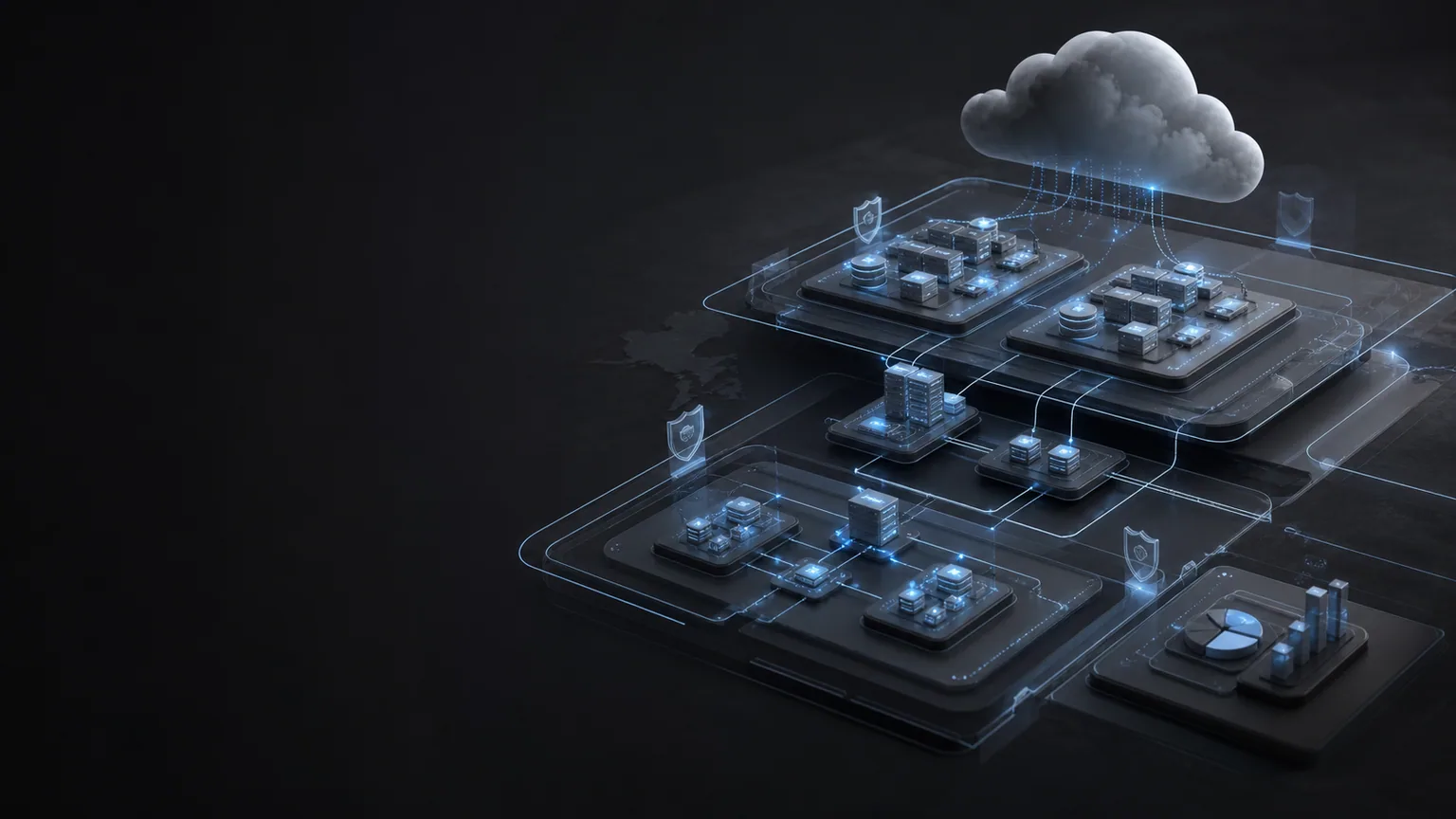
Concept illustration: AWS cloud architecture with resilient infrastructure zones, private networks, compute, storage, and security controls

Cloud & platforms · India and global delivery

AWS Cloud Architecture

Secure, reliable, cost-aware AWS foundations for applications, APIs, containers, data, AI workloads, backups, and global delivery.

Service overview

A foundation designed around the operating reality

Cloud design is a set of business trade-offs across operations, security, reliability, performance, cost, and sustainability. We make those choices visible, automate the foundation, and keep the architecture proportional to the workload rather than the service catalogue.

What we build

Capability with an operating model

The deliverable includes decisions, system boundaries, quality controls, documentation, and ownership—not only implementation.

01

Landing zone and workload design

Define accounts, regions, identity, networks, compute, storage, data services, environments, and responsibility boundaries.

02

Security and resilience

Apply least privilege, secrets management, encryption, backup, restore testing, failure isolation, and recovery objectives.

03

Containers and serverless

Select EC2, ECS, Lambda, managed services, or simpler static delivery based on workload behavior and operational capacity.

04

Cost and operations

Design tagging, budgets, right-sizing, schedules, logs, metrics, alerts, runbooks, and continuous architecture review.

End-to-end engagement

From discovery through improvement

Deepak remains connected to business direction, architecture, implementation quality, and stakeholder decisions through the engagement.

  1. 01

    Discover

    Align buyers, users, business outcomes, constraints, current systems, evidence, risks, and the smallest useful scope.

  2. 02

    Architect

    Make boundaries, data, integrations, security, quality attributes, operating ownership, and trade-offs explicit.

  3. 03

    Deliver

    Build in reviewable increments with tests, demonstrations, documentation, acceptance criteria, and stakeholder visibility.

  4. 04

    Operate and improve

    Deploy, observe, support, learn from real use, and prioritize the next improvement using evidence.

Buyer paths

Different constraints. One accountable foundation.

The scope changes by maturity and risk while the engineering standard remains explicit.

Funded product teams

Establish a secure cloud foundation that supports delivery without premature platform complexity.

Growing businesses

Move applications to AWS or improve cost, backup, security, and operational visibility.

Enterprise teams

Review workloads against explicit security, reliability, performance, cost, and governance requirements.

Relevant experience

Anonymized delivery context

Hands-on architecture includes S3 and CloudFront delivery, Route 53, EC2, ECS, ECR, Lambda, Systems Manager, backup automation, databases, budgets, and multi-service application platforms.

Typical engagement targets

Measures agreed before claims

These are planning targets, not guaranteed or fabricated client results. Baselines and acceptance criteria are confirmed during discovery.

  • Resolve high-priority architecture risks against agreed business needs
  • Make monthly cost drivers and budget thresholds visible
  • Prove backup, restore, deployment, and incident paths before production

Technology foundation

Tools selected after the constraints

  • AWS
  • ECS
  • EC2
  • Lambda
  • S3
  • CloudFront
  • Route 53
  • IAM
  • SSM
  • Terraform
  • CloudWatch

Questions

Before an engagement starts

Clear constraints produce a better technical decision and a more useful first scope.

Do you use managed AWS services for everything?

No. Managed services reduce some operational work but can add cost, coupling, and complexity. We choose the simplest service that fits reliability, security, scale, and team capacity.

Can you optimize an existing AWS environment?

Yes. Reviews cover architecture, spend, idle capacity, storage, data transfer, identity, backup, observability, release paths, and operational ownership.

Connected capabilities

Most production outcomes cross product, backend, cloud, data, and operational boundaries.