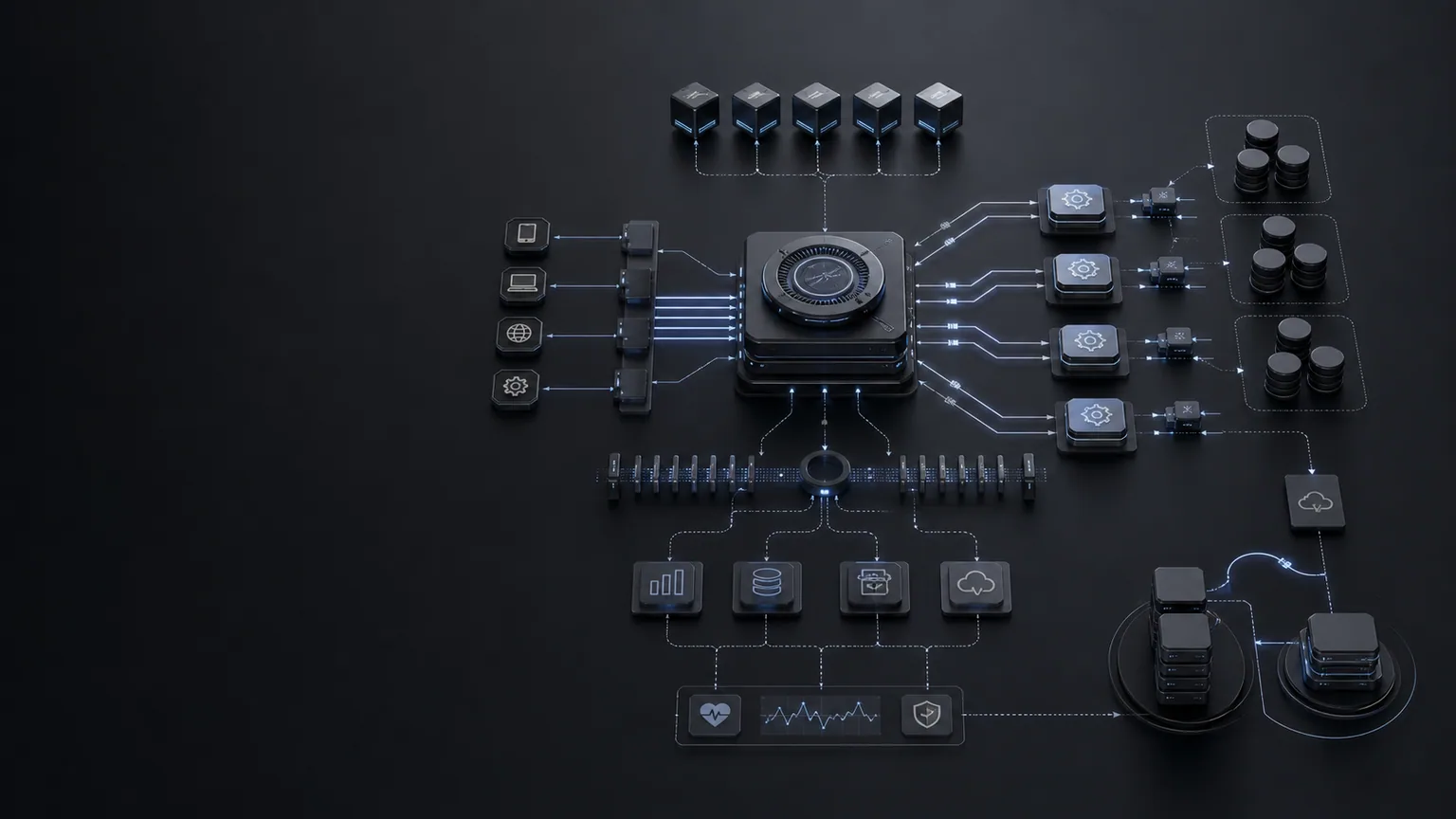
Concept illustration: Golang backend and API architecture with domain services, event streams, databases, health monitoring, and failover

Foundation technology · India and global delivery

Golang Backend & API Engineering

Focused Golang APIs, microservices, event-driven backends, and data boundaries designed for reliability, clarity, and operability.

Service overview

A foundation designed around the operating reality

Backend architecture is an ownership model expressed in software. We define domains, contracts, data responsibility, failure behavior, security, observability, and deployment before splitting a system into services. Golang is used where its simplicity and runtime profile fit the product.

What we build

Capability with an operating model

The deliverable includes decisions, system boundaries, quality controls, documentation, and ownership—not only implementation.

01

Domain and API architecture

Model business rules, resource ownership, contracts, versioning, authorization, idempotency, and integration boundaries.

02

Service implementation

Build maintainable Go services with explicit dependencies, predictable configuration, tests, and resource limits.

03

Data and event workflows

Design transactional boundaries, PostgreSQL access, caching, queues, background jobs, and event-driven coordination.

04

Production operations

Add health checks, structured logs, metrics, tracing, graceful shutdown, migrations, and safe deployment behavior.

End-to-end engagement

From discovery through improvement

Deepak remains connected to business direction, architecture, implementation quality, and stakeholder decisions through the engagement.

  1. 01

    Discover

    Align buyers, users, business outcomes, constraints, current systems, evidence, risks, and the smallest useful scope.

  2. 02

    Architect

    Make boundaries, data, integrations, security, quality attributes, operating ownership, and trade-offs explicit.

  3. 03

    Deliver

    Build in reviewable increments with tests, demonstrations, documentation, acceptance criteria, and stakeholder visibility.

  4. 04

    Operate and improve

    Deploy, observe, support, learn from real use, and prioritize the next improvement using evidence.

Buyer paths

Different constraints. One accountable foundation.

The scope changes by maturity and risk while the engineering standard remains explicit.

Funded product teams

Create a backend foundation that supports fast product work without accumulating invisible operational risk.

Growing businesses

Replace overloaded applications or fragile integrations with clear APIs and dependable workflows.

Enterprise teams

Modernize service boundaries and data ownership across complex, multi-team platforms.

Relevant experience

Anonymized delivery context

Relevant work includes distributed HRTech architecture spanning 15+ services, healthcare and reporting APIs, real-time systems, data platforms, and containerized backend delivery.

Typical engagement targets

Measures agreed before claims

These are planning targets, not guaranteed or fabricated client results. Baselines and acceptance criteria are confirmed during discovery.

  • Meet agreed latency, availability, and resource envelopes
  • Make service ownership and failure behavior explicit
  • Create repeatable testing, migration, and deployment paths

Technology foundation

Tools selected after the constraints

  • Golang
  • REST
  • gRPC
  • PostgreSQL
  • Redis
  • Events
  • Docker
  • OpenTelemetry
  • Contract testing

Questions

Before an engagement starts

Clear constraints produce a better technical decision and a more useful first scope.

Do we need microservices?

Not automatically. A modular monolith is often the stronger starting point. Services are separated when ownership, scaling, deployment, isolation, or organizational boundaries justify the cost.

Can Go services integrate with an existing Node.js or Java platform?

Yes. We design explicit APIs, events, data ownership, and migration stages so new Go services can coexist with current systems.

Connected capabilities

Most production outcomes cross product, backend, cloud, data, and operational boundaries.